
Swift Spies Comet Lulin
How Lulin is x-rayed
 © NASA/Swift/Univ. of Leicester/Bodewits et al. |
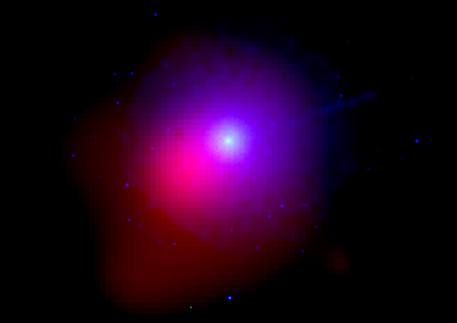
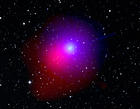
This image of Comet Lulin taken Jan. 28 merges data acquired by Swift's Ultraviolet/Optical Telescope (blue and green) and X-Ray Telescope (red).
The UVOT includes a prism-like device called a grism, which separates incoming light by wavelength. The grism's range includes wavelengths in which the hydroxyl molecule is most active. "This gives us a unique view into the types and quantities of gas a comet produces, which gives us clues about the origin of comets and the solar system," Bodewits explains. Swift is currently the only space observatory covering this wavelength range.
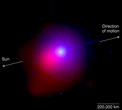
In the Swift images, the comet's tail extends off to the right. Solar radiation pushes icy grains away from the comet. As the grains gradually evaporate, they create a thin hydroxyl tail.
Farther from the comet, even the hydroxyl molecule succumbs to solar ultraviolet radiation. It breaks into its constituent oxygen and hydrogen atoms. "The solar wind -- a fast-moving stream of particles from the sun -- interacts with the comet's broader cloud of atoms. This causes the solar wind to light up with X rays, and that's what Swift's XRT sees," said Stefan Immler, also at Goddard.
This interaction, called charge exchange, results in X-rays from most comets when they pass within about three times Earth's distance from the sun. Because Lulin is so active, its atomic cloud is especially dense. As a result, the X-ray-emitting region extends far sunward of the comet.
"We are looking forward to future observations of Comet Lulin, when we hope to get better X-ray data to help us determine its makeup," noted Carter. "They will allow us to build up a more complete 3-D picture of the comet during its flight through the solar system."
Other members of the team include Michael Mumma and Geronimo Villanueva at Goddard.
NASA's Goddard Space Flight Center in Greenbelt, Md., manages the Swift satellite. It is being operated in collaboration with partners in the U.S., the United Kingdom, Italy, Germany and Japan. NASA's Fermi Gamma-ray Space Telescope is an astrophysics and particle physics observatory developed in collaboration with the U.S. Department of Energy and with important contributions from academic institutions and partners in France, Germany, Italy, Japan, Sweden, and the U.S.
Credit: NASA
In the Swift images, the comet's tail extends off to the right. Solar radiation pushes icy grains away from the comet. As the grains gradually evaporate, they create a thin hydroxyl tail.
Farther from the comet, even the hydroxyl molecule succumbs to solar ultraviolet radiation. It breaks into its constituent oxygen and hydrogen atoms. "The solar wind -- a fast-moving stream of particles from the sun -- interacts with the comet's broader cloud of atoms. This causes the solar wind to light up with X rays, and that's what Swift's XRT sees," said Stefan Immler, also at Goddard.
This interaction, called charge exchange, results in X-rays from most comets when they pass within about three times Earth's distance from the sun. Because Lulin is so active, its atomic cloud is especially dense. As a result, the X-ray-emitting region extends far sunward of the comet.
"We are looking forward to future observations of Comet Lulin, when we hope to get better X-ray data to help us determine its makeup," noted Carter. "They will allow us to build up a more complete 3-D picture of the comet during its flight through the solar system."
Other members of the team include Michael Mumma and Geronimo Villanueva at Goddard.
NASA's Goddard Space Flight Center in Greenbelt, Md., manages the Swift satellite. It is being operated in collaboration with partners in the U.S., the United Kingdom, Italy, Germany and Japan. NASA's Fermi Gamma-ray Space Telescope is an astrophysics and particle physics observatory developed in collaboration with the U.S. Department of Energy and with important contributions from academic institutions and partners in France, Germany, Italy, Japan, Sweden, and the U.S.
Credit: NASA
Pictures of the article
 |
 |
|



Swift Spies Comet Lulin
How Lulin is x-rayed
© NASA/Swift/Univ. of Leicester/Bodewits et al. |
This image of Comet Lulin taken Jan. 28 merges data acquired by Swift's Ultraviolet/Optical Telescope (blue and green) and X-Ray Telescope (red).
The UVOT includes a prism-like device called a grism, which separates incoming light by wavelength. The grism's range includes wavelengths in which the hydroxyl molecule is most active. "This gives us a unique view into the types and quantities of gas a comet produces, which gives us clues about the origin of comets and the solar system," Bodewits explains. Swift is currently the only space observatory covering this wavelength range.
In the Swift images, the comet's tail extends off to the right. Solar radiation pushes icy grains away from the comet. As the grains gradually evaporate, they create a thin hydroxyl tail.
Farther from the comet, even the hydroxyl molecule succumbs to solar ultraviolet radiation. It breaks into its constituent oxygen and hydrogen atoms. "The solar wind -- a fast-moving stream of particles from the sun -- interacts with the comet's broader cloud of atoms. This causes the solar wind to light up with X rays, and that's what Swift's XRT sees," said Stefan Immler, also at Goddard.
This interaction, called charge exchange, results in X-rays from most comets when they pass within about three times Earth's distance from the sun. Because Lulin is so active, its atomic cloud is especially dense. As a result, the X-ray-emitting region extends far sunward of the comet.
"We are looking forward to future observations of Comet Lulin, when we hope to get better X-ray data to help us determine its makeup," noted Carter. "They will allow us to build up a more complete 3-D picture of the comet during its flight through the solar system."
Other members of the team include Michael Mumma and Geronimo Villanueva at Goddard.
NASA's Goddard Space Flight Center in Greenbelt, Md., manages the Swift satellite. It is being operated in collaboration with partners in the U.S., the United Kingdom, Italy, Germany and Japan. NASA's Fermi Gamma-ray Space Telescope is an astrophysics and particle physics observatory developed in collaboration with the U.S. Department of Energy and with important contributions from academic institutions and partners in France, Germany, Italy, Japan, Sweden, and the U.S.
Credit: NASA
In the Swift images, the comet's tail extends off to the right. Solar radiation pushes icy grains away from the comet. As the grains gradually evaporate, they create a thin hydroxyl tail.
Farther from the comet, even the hydroxyl molecule succumbs to solar ultraviolet radiation. It breaks into its constituent oxygen and hydrogen atoms. "The solar wind -- a fast-moving stream of particles from the sun -- interacts with the comet's broader cloud of atoms. This causes the solar wind to light up with X rays, and that's what Swift's XRT sees," said Stefan Immler, also at Goddard.
This interaction, called charge exchange, results in X-rays from most comets when they pass within about three times Earth's distance from the sun. Because Lulin is so active, its atomic cloud is especially dense. As a result, the X-ray-emitting region extends far sunward of the comet.
"We are looking forward to future observations of Comet Lulin, when we hope to get better X-ray data to help us determine its makeup," noted Carter. "They will allow us to build up a more complete 3-D picture of the comet during its flight through the solar system."
Other members of the team include Michael Mumma and Geronimo Villanueva at Goddard.
NASA's Goddard Space Flight Center in Greenbelt, Md., manages the Swift satellite. It is being operated in collaboration with partners in the U.S., the United Kingdom, Italy, Germany and Japan. NASA's Fermi Gamma-ray Space Telescope is an astrophysics and particle physics observatory developed in collaboration with the U.S. Department of Energy and with important contributions from academic institutions and partners in France, Germany, Italy, Japan, Sweden, and the U.S.
Credit: NASA
Pictures of the article
|
|
|


- Terms of use
- Privacy Policy
- About us
- Contact us
- FAQ
- Report abuse
- Subscribe to the newsletter
- Partner Program
- Advertise with us
- Partners
- Sitemap
- Muster-Widerrufsformular
* Alle Preise inkl. gesetzl. MwSt. Zahlung- & Versandinformationen unseres Partners HQ Media
Swift Spies Comet Lulin
How Lulin is x-rayed
© NASA/Swift/Univ. of Leicester/Bodewits et al. |
This image of Comet Lulin taken Jan. 28 merges data acquired by Swift's Ultraviolet/Optical Telescope (blue and green) and X-Ray Telescope (red).
The UVOT includes a prism-like device called a grism, which separates incoming light by wavelength. The grism's range includes wavelengths in which the hydroxyl molecule is most active. "This gives us a unique view into the types and quantities of gas a comet produces, which gives us clues about the origin of comets and the solar system," Bodewits explains. Swift is currently the only space observatory covering this wavelength range.
In the Swift images, the comet's tail extends off to the right. Solar radiation pushes icy grains away from the comet. As the grains gradually evaporate, they create a thin hydroxyl tail.
Farther from the comet, even the hydroxyl molecule succumbs to solar ultraviolet radiation. It breaks into its constituent oxygen and hydrogen atoms. "The solar wind -- a fast-moving stream of particles from the sun -- interacts with the comet's broader cloud of atoms. This causes the solar wind to light up with X rays, and that's what Swift's XRT sees," said Stefan Immler, also at Goddard.
This interaction, called charge exchange, results in X-rays from most comets when they pass within about three times Earth's distance from the sun. Because Lulin is so active, its atomic cloud is especially dense. As a result, the X-ray-emitting region extends far sunward of the comet.
"We are looking forward to future observations of Comet Lulin, when we hope to get better X-ray data to help us determine its makeup," noted Carter. "They will allow us to build up a more complete 3-D picture of the comet during its flight through the solar system."
Other members of the team include Michael Mumma and Geronimo Villanueva at Goddard.
NASA's Goddard Space Flight Center in Greenbelt, Md., manages the Swift satellite. It is being operated in collaboration with partners in the U.S., the United Kingdom, Italy, Germany and Japan. NASA's Fermi Gamma-ray Space Telescope is an astrophysics and particle physics observatory developed in collaboration with the U.S. Department of Energy and with important contributions from academic institutions and partners in France, Germany, Italy, Japan, Sweden, and the U.S.
Credit: NASA
In the Swift images, the comet's tail extends off to the right. Solar radiation pushes icy grains away from the comet. As the grains gradually evaporate, they create a thin hydroxyl tail.
Farther from the comet, even the hydroxyl molecule succumbs to solar ultraviolet radiation. It breaks into its constituent oxygen and hydrogen atoms. "The solar wind -- a fast-moving stream of particles from the sun -- interacts with the comet's broader cloud of atoms. This causes the solar wind to light up with X rays, and that's what Swift's XRT sees," said Stefan Immler, also at Goddard.
This interaction, called charge exchange, results in X-rays from most comets when they pass within about three times Earth's distance from the sun. Because Lulin is so active, its atomic cloud is especially dense. As a result, the X-ray-emitting region extends far sunward of the comet.
"We are looking forward to future observations of Comet Lulin, when we hope to get better X-ray data to help us determine its makeup," noted Carter. "They will allow us to build up a more complete 3-D picture of the comet during its flight through the solar system."
Other members of the team include Michael Mumma and Geronimo Villanueva at Goddard.
NASA's Goddard Space Flight Center in Greenbelt, Md., manages the Swift satellite. It is being operated in collaboration with partners in the U.S., the United Kingdom, Italy, Germany and Japan. NASA's Fermi Gamma-ray Space Telescope is an astrophysics and particle physics observatory developed in collaboration with the U.S. Department of Energy and with important contributions from academic institutions and partners in France, Germany, Italy, Japan, Sweden, and the U.S.
Credit: NASA
Pictures of the article
|
|
|