
Swift Spies Comet Lulin
Lulin closest to earth last night
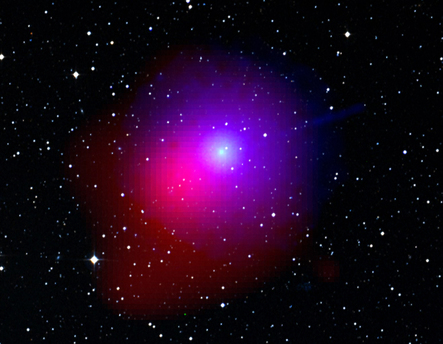
While waiting for high-energy outbursts and cosmic explosions, NASA's Swift Gamma-ray Explorer satellite is monitoring Comet Lulin as it closes on Earth. For the first time, astronomers are seeing simultaneous ultraviolet and X-ray images of a comet.
 © NASA/Swift/Univ. of Leicester/DSS (STScI, AURUA)/Bodewits et al. |
Comet Lulin was passing through the constellation Libra when Swift imaged it. This view merges the Swift data with a Digital Sky Survey image of the star field.
Article Content
- » 1 - 2/23 Lulin closest last night
- » 2 - How Lulin is x-rayed
2/23 Lulin closest last night
"Dirty Snowball" came close last night
"We won't be able to send a space probe to Comet Lulin, but Swift is giving us some of the information we would get from just such a mission," said Jenny Carter, at the University of Leicester, U.K., who is leading the study."The comet is releasing a great amount of gas, which makes it an ideal target for X-ray observations," said Andrew Read, also at Leicester.
A comet is a clump of frozen gases mixed with dust. These "dirty snowballs" cast off gas and dust whenever they venture near the sun. Comet Lulin, which is formally known as C/2007 N3, was discovered last year by astronomers at Taiwan's Lulin Observatory. The comet is now faintly visible from a dark site. Lulin will pass closest to Earth -- 38 million miles, or about 160 times farther than the moon -- late on the evening of Feb. 23 for North America.
On Jan. 28, Swift trained its Ultraviolet/Optical Telescope (UVOT) and X-Ray Telescope (XRT) on Comet Lulin. "The comet is quite active," said team member Dennis Bodewits, a NASA Postdoctoral Fellow at the Goddard Space Flight Center in Greenbelt, Md. "The UVOT data show that Lulin was shedding nearly 800 gallons of water each second." That's enough to fill an Olympic-size swimming pool in less than 15 minutes.
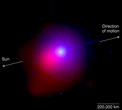
Swift can't see water directly. But ultraviolet light from the sun quickly breaks apart water molecules into hydrogen atoms and hydroxyl (OH) molecules. Swift's UVOT detects the hydroxyl molecules, and its images of Lulin reveal a hydroxyl cloud spanning nearly 250,000 miles, or slightly greater than the distance between Earth and the moon.
Pictures of the article
 |
 |
|
Read More:
» How Lulin is x-rayed



Swift Spies Comet Lulin
Lulin closest to earth last night
While waiting for high-energy outbursts and cosmic explosions, NASA's Swift Gamma-ray Explorer satellite is monitoring Comet Lulin as it closes on Earth. For the first time, astronomers are seeing simultaneous ultraviolet and X-ray images of a comet.
© NASA/Swift/Univ. of Leicester/DSS (STScI, AURUA)/Bodewits et al. |
Comet Lulin was passing through the constellation Libra when Swift imaged it. This view merges the Swift data with a Digital Sky Survey image of the star field.
Article Content
- » 1 - 2/23 Lulin closest last night
- » 2 - How Lulin is x-rayed
2/23 Lulin closest last night
"Dirty Snowball" came close last night
"We won't be able to send a space probe to Comet Lulin, but Swift is giving us some of the information we would get from just such a mission," said Jenny Carter, at the University of Leicester, U.K., who is leading the study."The comet is releasing a great amount of gas, which makes it an ideal target for X-ray observations," said Andrew Read, also at Leicester.
A comet is a clump of frozen gases mixed with dust. These "dirty snowballs" cast off gas and dust whenever they venture near the sun. Comet Lulin, which is formally known as C/2007 N3, was discovered last year by astronomers at Taiwan's Lulin Observatory. The comet is now faintly visible from a dark site. Lulin will pass closest to Earth -- 38 million miles, or about 160 times farther than the moon -- late on the evening of Feb. 23 for North America.
On Jan. 28, Swift trained its Ultraviolet/Optical Telescope (UVOT) and X-Ray Telescope (XRT) on Comet Lulin. "The comet is quite active," said team member Dennis Bodewits, a NASA Postdoctoral Fellow at the Goddard Space Flight Center in Greenbelt, Md. "The UVOT data show that Lulin was shedding nearly 800 gallons of water each second." That's enough to fill an Olympic-size swimming pool in less than 15 minutes.
Swift can't see water directly. But ultraviolet light from the sun quickly breaks apart water molecules into hydrogen atoms and hydroxyl (OH) molecules. Swift's UVOT detects the hydroxyl molecules, and its images of Lulin reveal a hydroxyl cloud spanning nearly 250,000 miles, or slightly greater than the distance between Earth and the moon.



- Terms of use
- Privacy Policy
- About us
- Contact us
- FAQ
- Report abuse
- Subscribe to the newsletter
- Partner Program
- Advertise with us
- Partners
- Sitemap
- Muster-Widerrufsformular
* Alle Preise inkl. gesetzl. MwSt. Zahlung- & Versandinformationen unseres Partners HQ Media
Swift Spies Comet Lulin
Lulin closest to earth last night
While waiting for high-energy outbursts and cosmic explosions, NASA's Swift Gamma-ray Explorer satellite is monitoring Comet Lulin as it closes on Earth. For the first time, astronomers are seeing simultaneous ultraviolet and X-ray images of a comet.
© NASA/Swift/Univ. of Leicester/DSS (STScI, AURUA)/Bodewits et al. |
Comet Lulin was passing through the constellation Libra when Swift imaged it. This view merges the Swift data with a Digital Sky Survey image of the star field.
Article Content
- » 1 - 2/23 Lulin closest last night
- » 2 - How Lulin is x-rayed
2/23 Lulin closest last night
"Dirty Snowball" came close last night
"We won't be able to send a space probe to Comet Lulin, but Swift is giving us some of the information we would get from just such a mission," said Jenny Carter, at the University of Leicester, U.K., who is leading the study."The comet is releasing a great amount of gas, which makes it an ideal target for X-ray observations," said Andrew Read, also at Leicester.
A comet is a clump of frozen gases mixed with dust. These "dirty snowballs" cast off gas and dust whenever they venture near the sun. Comet Lulin, which is formally known as C/2007 N3, was discovered last year by astronomers at Taiwan's Lulin Observatory. The comet is now faintly visible from a dark site. Lulin will pass closest to Earth -- 38 million miles, or about 160 times farther than the moon -- late on the evening of Feb. 23 for North America.
On Jan. 28, Swift trained its Ultraviolet/Optical Telescope (UVOT) and X-Ray Telescope (XRT) on Comet Lulin. "The comet is quite active," said team member Dennis Bodewits, a NASA Postdoctoral Fellow at the Goddard Space Flight Center in Greenbelt, Md. "The UVOT data show that Lulin was shedding nearly 800 gallons of water each second." That's enough to fill an Olympic-size swimming pool in less than 15 minutes.
Swift can't see water directly. But ultraviolet light from the sun quickly breaks apart water molecules into hydrogen atoms and hydroxyl (OH) molecules. Swift's UVOT detects the hydroxyl molecules, and its images of Lulin reveal a hydroxyl cloud spanning nearly 250,000 miles, or slightly greater than the distance between Earth and the moon.