New space telescope Kepler
A telescope in search for a "Second Earth"
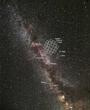
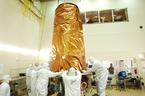
Very rarely are telescopes built to observe just one kind of celestial body. However, this is exactly the case for the new telescope "Kepler" made in the U.S.A. It is supposed to stare at the same region of the sky. There are great hopes for the $600 Million project. For the first time astronomers want to spot planets outside of our solar system, which are similar to Earth. The observations are very sensitive, for that reason the reflecting telescope will be brought into orbit, where the atmosphere will not interfere. The start of the roughly 2200 pound Kepler is planned by NASA for late Friday, March 6th.
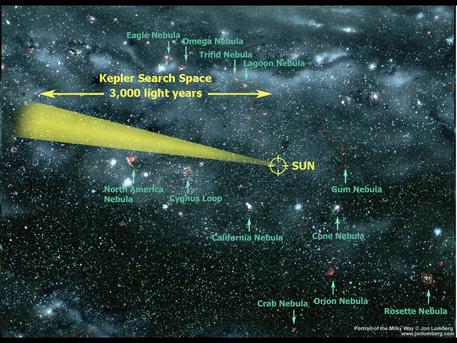 © Jon Lomberg, NASA |
An artists rendering of what our galaxy might look as viewed from outside our Galaxy. Our sun is about 25,000 light years from the center of the galaxy. The cone illustrates the neighborhood of our galaxy that the Kepler Mission will search to find habita
Inhalt des Artikels
- » 1 - Search for habitable planets
- » 2 - Twelve times the light of Corot
Search for habitable planets
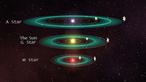
Providing proof for planets of far away stars is always difficult. The huge difference in the brightness between the planet and it's central star usually prevents the direct detection of these extrasolar worlds. Nearly all of the 300 exoplanets were caught using indirect methods. None of them deserves the title "Second Earth", because several conditions need to be met simultaneously. For starters the mass of the planet has to be similar to Earth's. Then the distance to the central star and the type of that star matters. Both determine the temperature of the exoplanet. If these conditions allow for liquid water on the surface then the planet is in the so called habitable zone of its home planet.