
Age of the Universe
How old is the Universe?
 © NASA/H.Richer/NOAO/AURA/NSF |
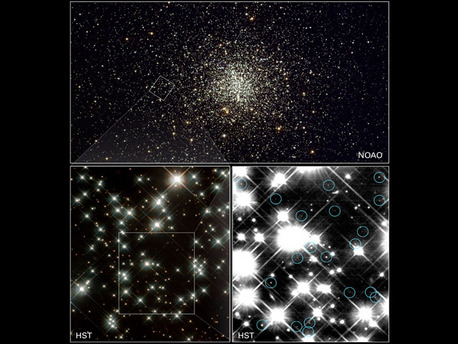
The upper photograph shows the entire globular cluster, which contains several hundred thousand stars. The two lower photographs each show an enlargement of the extract marked. The weak light spots circled in blue are white dwarfs. They are between 12 and 13 billion years old and are probably some of the oldest stars in the Universe.
As a result, the oldest stars must have only a relatively low mass and contain hardly any heavy elements. Stars such as this can, for example, be found in the globular clusters that are grouped around the Milky Way. In particular, white dwarf stars, which have consumed their nuclear fuel and are slowly cooling down, can be used for age determination. Observations of the globular clusters and the cooling time of white dwarfs allow us to conclude that the age of the Milky Way is approximately 12 billion years.
The Milky Way – only a little younger than the Universe
Independent of the age of individual objects that allow a minimum age to be determined for the Universe, its age can also be determined using the Big Bang theory. To do this, we use the expansion of the Universe after the Big Bang, the same expansion that is continuing today, to calculate backwards – back in time until the zero point of the expansion. However, cosmic expansion has not always taken place evenly; this would only have been the case in a completely empty Universe. Radiation, matter (including 'dark matter') and dark energy influence this expansion. Astronomers determine these influences using satellite observations, among other things, and ultimately they calculate that the Universe is 13.7 billion years old.



Age of the Universe
How old is the Universe?
© NASA/H.Richer/NOAO/AURA/NSF |
The upper photograph shows the entire globular cluster, which contains several hundred thousand stars. The two lower photographs each show an enlargement of the extract marked. The weak light spots circled in blue are white dwarfs. They are between 12 and 13 billion years old and are probably some of the oldest stars in the Universe.
As a result, the oldest stars must have only a relatively low mass and contain hardly any heavy elements. Stars such as this can, for example, be found in the globular clusters that are grouped around the Milky Way. In particular, white dwarf stars, which have consumed their nuclear fuel and are slowly cooling down, can be used for age determination. Observations of the globular clusters and the cooling time of white dwarfs allow us to conclude that the age of the Milky Way is approximately 12 billion years.
The Milky Way – only a little younger than the Universe
Independent of the age of individual objects that allow a minimum age to be determined for the Universe, its age can also be determined using the Big Bang theory. To do this, we use the expansion of the Universe after the Big Bang, the same expansion that is continuing today, to calculate backwards – back in time until the zero point of the expansion. However, cosmic expansion has not always taken place evenly; this would only have been the case in a completely empty Universe. Radiation, matter (including 'dark matter') and dark energy influence this expansion. Astronomers determine these influences using satellite observations, among other things, and ultimately they calculate that the Universe is 13.7 billion years old.


- Terms of use
- Privacy Policy
- About us
- Contact us
- FAQ
- Report abuse
- Subscribe to the newsletter
- Partner Program
- Advertise with us
- Partners
- Sitemap
- Muster-Widerrufsformular
* Alle Preise inkl. gesetzl. MwSt. Zahlung- & Versandinformationen unseres Partners HQ Media
Age of the Universe
How old is the Universe?
© NASA/H.Richer/NOAO/AURA/NSF |
The upper photograph shows the entire globular cluster, which contains several hundred thousand stars. The two lower photographs each show an enlargement of the extract marked. The weak light spots circled in blue are white dwarfs. They are between 12 and 13 billion years old and are probably some of the oldest stars in the Universe.
As a result, the oldest stars must have only a relatively low mass and contain hardly any heavy elements. Stars such as this can, for example, be found in the globular clusters that are grouped around the Milky Way. In particular, white dwarf stars, which have consumed their nuclear fuel and are slowly cooling down, can be used for age determination. Observations of the globular clusters and the cooling time of white dwarfs allow us to conclude that the age of the Milky Way is approximately 12 billion years.
The Milky Way – only a little younger than the Universe
Independent of the age of individual objects that allow a minimum age to be determined for the Universe, its age can also be determined using the Big Bang theory. To do this, we use the expansion of the Universe after the Big Bang, the same expansion that is continuing today, to calculate backwards – back in time until the zero point of the expansion. However, cosmic expansion has not always taken place evenly; this would only have been the case in a completely empty Universe. Radiation, matter (including 'dark matter') and dark energy influence this expansion. Astronomers determine these influences using satellite observations, among other things, and ultimately they calculate that the Universe is 13.7 billion years old.