
Inhospitable Atmosphere and an Icy Heart
New Super-Earth Found
Astronomers have discovered the second super-Earth exoplanet. A super-Earth is defined as a planet between one and ten times the mass of the Earth. An exoplanet is a planet orbiting a star other than the Sun.
 © ESO/L. Calçada |
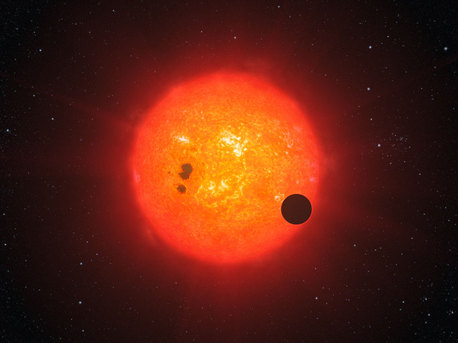
Exoplanet GJ1214b (Artisit's impression).
Scientists have determined the mass and radius of the exoplanet, giving vital clues about its structure. It is also the first super-Earth where an atmosphere has been found. The exoplanet, orbiting a small star only 40 light-years away from us, opens up dramatic new perspectives in the quest for habitable worlds. The planet, GJ1214b, has a mass about six times that of Earth and its interior is likely to be mostly made of water ice. Its surface appears to be fairly hot and the planet is surrounded by a thick atmosphere, which makes it inhospitable for life as we know it on Earth.
In this week’s issue of Nature, astronomers announce the discovery of a planet around the nearby, low-mass star GJ1214. It is the second time a transiting super-Earth has been detected, after the recent discovery of the planet Corot-7b (read more about Corot here). A transit occurs when the planet's orbit is aligned so that we see it crossing the face of its parent star. The newly discovered planet has a mass about six times that of our terrestrial home and 2.7 times its radius, falling in size between the Earth and the ice giants of the Solar System, Uranus and Neptune.
Although the mass of GJ1214b is similar to that of Corot-7b, its radius is much larger, suggesting that the composition of the two planets must be quite different. While Corot-7b probably has a rocky core and may be covered with lava, astronomers believe that three quarters of GJ1214b is composed of water ice, the rest being made of silicon and iron.
GJ1214b orbits its star once every 38 hours at a distance of only 1.3 million miles — 70 times closer to its star than the Earth is to the Sun. “Being so close to its host star, the planet must have a surface temperature of about 200 degrees Celsius, too hot for water to be liquid,” says David Charbonneau, lead author of the paper reporting the discovery.
When the astronomers found that the observed radius exceeds the model predictions: there is something more than the planet’s solid surface blocking the star’s light — a surrounding atmosphere, 130 miles thick. “This atmosphere is much thicker than that of the Earth, so the high pressure and absence of light would rule out life as we know it,” says Charbonneau, “but these conditions are still very interesting, as they could allow for some complex chemistry to take place.”
“Because the planet is too hot to have kept an atmosphere for long, GJ1214b represents the first opportunity to study a newly formed atmosphere enshrouding a world orbiting another star,” adds team member Xavier Bonfils. “Because the planet is so close to us, it will be possible to study its atmosphere even with current facilities.”
The planet was first discovered as a transiting object within the MEarth project, which follows about 2000 low-mass stars to look for transits by exoplanets [4]. To confirm the planetary nature of GJ1214b and to obtain its mass (using the so-called Doppler method), the astronomers needed the full precision of the HARPS spectrograph, attached to ESO’s 3.6-metre telescope at La Silla. An instrument with unrivalled stability and great precision, HARPS is the world’s most successful hunter for small exoplanets.
“This is the second super-Earth exoplanet for which the mass and radius could be obtained, allowing us to determine the density and to infer the inner structure,” adds co-author Stephane Udry. “In both cases, data from HARPS was essential to characterise the planet.”
“The differences in composition between these two planets are relevant to the quest for habitable worlds,” concludes Charbonneau. If super-Earth planets in general are surrounded by an atmosphere similar to that of GJ1214b, they may well be inhospitable to the development of life as we know it on our own planet.
Source: ESO
In this week’s issue of Nature, astronomers announce the discovery of a planet around the nearby, low-mass star GJ1214. It is the second time a transiting super-Earth has been detected, after the recent discovery of the planet Corot-7b (read more about Corot here). A transit occurs when the planet's orbit is aligned so that we see it crossing the face of its parent star. The newly discovered planet has a mass about six times that of our terrestrial home and 2.7 times its radius, falling in size between the Earth and the ice giants of the Solar System, Uranus and Neptune.
Although the mass of GJ1214b is similar to that of Corot-7b, its radius is much larger, suggesting that the composition of the two planets must be quite different. While Corot-7b probably has a rocky core and may be covered with lava, astronomers believe that three quarters of GJ1214b is composed of water ice, the rest being made of silicon and iron.
GJ1214b orbits its star once every 38 hours at a distance of only 1.3 million miles — 70 times closer to its star than the Earth is to the Sun. “Being so close to its host star, the planet must have a surface temperature of about 200 degrees Celsius, too hot for water to be liquid,” says David Charbonneau, lead author of the paper reporting the discovery.
When the astronomers found that the observed radius exceeds the model predictions: there is something more than the planet’s solid surface blocking the star’s light — a surrounding atmosphere, 130 miles thick. “This atmosphere is much thicker than that of the Earth, so the high pressure and absence of light would rule out life as we know it,” says Charbonneau, “but these conditions are still very interesting, as they could allow for some complex chemistry to take place.”
“Because the planet is too hot to have kept an atmosphere for long, GJ1214b represents the first opportunity to study a newly formed atmosphere enshrouding a world orbiting another star,” adds team member Xavier Bonfils. “Because the planet is so close to us, it will be possible to study its atmosphere even with current facilities.”
The planet was first discovered as a transiting object within the MEarth project, which follows about 2000 low-mass stars to look for transits by exoplanets [4]. To confirm the planetary nature of GJ1214b and to obtain its mass (using the so-called Doppler method), the astronomers needed the full precision of the HARPS spectrograph, attached to ESO’s 3.6-metre telescope at La Silla. An instrument with unrivalled stability and great precision, HARPS is the world’s most successful hunter for small exoplanets.
“This is the second super-Earth exoplanet for which the mass and radius could be obtained, allowing us to determine the density and to infer the inner structure,” adds co-author Stephane Udry. “In both cases, data from HARPS was essential to characterise the planet.”
“The differences in composition between these two planets are relevant to the quest for habitable worlds,” concludes Charbonneau. If super-Earth planets in general are surrounded by an atmosphere similar to that of GJ1214b, they may well be inhospitable to the development of life as we know it on our own planet.
Source: ESO



Inhospitable Atmosphere and an Icy Heart
New Super-Earth Found
Astronomers have discovered the second super-Earth exoplanet. A super-Earth is defined as a planet between one and ten times the mass of the Earth. An exoplanet is a planet orbiting a star other than the Sun.
© ESO/L. Calçada |
Exoplanet GJ1214b (Artisit's impression).
Scientists have determined the mass and radius of the exoplanet, giving vital clues about its structure. It is also the first super-Earth where an atmosphere has been found. The exoplanet, orbiting a small star only 40 light-years away from us, opens up dramatic new perspectives in the quest for habitable worlds. The planet, GJ1214b, has a mass about six times that of Earth and its interior is likely to be mostly made of water ice. Its surface appears to be fairly hot and the planet is surrounded by a thick atmosphere, which makes it inhospitable for life as we know it on Earth.
In this week’s issue of Nature, astronomers announce the discovery of a planet around the nearby, low-mass star GJ1214. It is the second time a transiting super-Earth has been detected, after the recent discovery of the planet Corot-7b (read more about Corot here). A transit occurs when the planet's orbit is aligned so that we see it crossing the face of its parent star. The newly discovered planet has a mass about six times that of our terrestrial home and 2.7 times its radius, falling in size between the Earth and the ice giants of the Solar System, Uranus and Neptune.
Although the mass of GJ1214b is similar to that of Corot-7b, its radius is much larger, suggesting that the composition of the two planets must be quite different. While Corot-7b probably has a rocky core and may be covered with lava, astronomers believe that three quarters of GJ1214b is composed of water ice, the rest being made of silicon and iron.
GJ1214b orbits its star once every 38 hours at a distance of only 1.3 million miles — 70 times closer to its star than the Earth is to the Sun. “Being so close to its host star, the planet must have a surface temperature of about 200 degrees Celsius, too hot for water to be liquid,” says David Charbonneau, lead author of the paper reporting the discovery.
When the astronomers found that the observed radius exceeds the model predictions: there is something more than the planet’s solid surface blocking the star’s light — a surrounding atmosphere, 130 miles thick. “This atmosphere is much thicker than that of the Earth, so the high pressure and absence of light would rule out life as we know it,” says Charbonneau, “but these conditions are still very interesting, as they could allow for some complex chemistry to take place.”
“Because the planet is too hot to have kept an atmosphere for long, GJ1214b represents the first opportunity to study a newly formed atmosphere enshrouding a world orbiting another star,” adds team member Xavier Bonfils. “Because the planet is so close to us, it will be possible to study its atmosphere even with current facilities.”
The planet was first discovered as a transiting object within the MEarth project, which follows about 2000 low-mass stars to look for transits by exoplanets [4]. To confirm the planetary nature of GJ1214b and to obtain its mass (using the so-called Doppler method), the astronomers needed the full precision of the HARPS spectrograph, attached to ESO’s 3.6-metre telescope at La Silla. An instrument with unrivalled stability and great precision, HARPS is the world’s most successful hunter for small exoplanets.
“This is the second super-Earth exoplanet for which the mass and radius could be obtained, allowing us to determine the density and to infer the inner structure,” adds co-author Stephane Udry. “In both cases, data from HARPS was essential to characterise the planet.”
“The differences in composition between these two planets are relevant to the quest for habitable worlds,” concludes Charbonneau. If super-Earth planets in general are surrounded by an atmosphere similar to that of GJ1214b, they may well be inhospitable to the development of life as we know it on our own planet.
Source: ESO
In this week’s issue of Nature, astronomers announce the discovery of a planet around the nearby, low-mass star GJ1214. It is the second time a transiting super-Earth has been detected, after the recent discovery of the planet Corot-7b (read more about Corot here). A transit occurs when the planet's orbit is aligned so that we see it crossing the face of its parent star. The newly discovered planet has a mass about six times that of our terrestrial home and 2.7 times its radius, falling in size between the Earth and the ice giants of the Solar System, Uranus and Neptune.
Although the mass of GJ1214b is similar to that of Corot-7b, its radius is much larger, suggesting that the composition of the two planets must be quite different. While Corot-7b probably has a rocky core and may be covered with lava, astronomers believe that three quarters of GJ1214b is composed of water ice, the rest being made of silicon and iron.
GJ1214b orbits its star once every 38 hours at a distance of only 1.3 million miles — 70 times closer to its star than the Earth is to the Sun. “Being so close to its host star, the planet must have a surface temperature of about 200 degrees Celsius, too hot for water to be liquid,” says David Charbonneau, lead author of the paper reporting the discovery.
When the astronomers found that the observed radius exceeds the model predictions: there is something more than the planet’s solid surface blocking the star’s light — a surrounding atmosphere, 130 miles thick. “This atmosphere is much thicker than that of the Earth, so the high pressure and absence of light would rule out life as we know it,” says Charbonneau, “but these conditions are still very interesting, as they could allow for some complex chemistry to take place.”
“Because the planet is too hot to have kept an atmosphere for long, GJ1214b represents the first opportunity to study a newly formed atmosphere enshrouding a world orbiting another star,” adds team member Xavier Bonfils. “Because the planet is so close to us, it will be possible to study its atmosphere even with current facilities.”
The planet was first discovered as a transiting object within the MEarth project, which follows about 2000 low-mass stars to look for transits by exoplanets [4]. To confirm the planetary nature of GJ1214b and to obtain its mass (using the so-called Doppler method), the astronomers needed the full precision of the HARPS spectrograph, attached to ESO’s 3.6-metre telescope at La Silla. An instrument with unrivalled stability and great precision, HARPS is the world’s most successful hunter for small exoplanets.
“This is the second super-Earth exoplanet for which the mass and radius could be obtained, allowing us to determine the density and to infer the inner structure,” adds co-author Stephane Udry. “In both cases, data from HARPS was essential to characterise the planet.”
“The differences in composition between these two planets are relevant to the quest for habitable worlds,” concludes Charbonneau. If super-Earth planets in general are surrounded by an atmosphere similar to that of GJ1214b, they may well be inhospitable to the development of life as we know it on our own planet.
Source: ESO


- Terms of use
- Privacy Policy
- About us
- Contact us
- FAQ
- Report abuse
- Subscribe to the newsletter
- Partner Program
- Advertise with us
- Partners
- Sitemap
- Muster-Widerrufsformular
* Alle Preise inkl. gesetzl. MwSt. Zahlung- & Versandinformationen unseres Partners HQ Media
Inhospitable Atmosphere and an Icy Heart
New Super-Earth Found
Astronomers have discovered the second super-Earth exoplanet. A super-Earth is defined as a planet between one and ten times the mass of the Earth. An exoplanet is a planet orbiting a star other than the Sun.
© ESO/L. Calçada |
Exoplanet GJ1214b (Artisit's impression).
Scientists have determined the mass and radius of the exoplanet, giving vital clues about its structure. It is also the first super-Earth where an atmosphere has been found. The exoplanet, orbiting a small star only 40 light-years away from us, opens up dramatic new perspectives in the quest for habitable worlds. The planet, GJ1214b, has a mass about six times that of Earth and its interior is likely to be mostly made of water ice. Its surface appears to be fairly hot and the planet is surrounded by a thick atmosphere, which makes it inhospitable for life as we know it on Earth.
In this week’s issue of Nature, astronomers announce the discovery of a planet around the nearby, low-mass star GJ1214. It is the second time a transiting super-Earth has been detected, after the recent discovery of the planet Corot-7b (read more about Corot here). A transit occurs when the planet's orbit is aligned so that we see it crossing the face of its parent star. The newly discovered planet has a mass about six times that of our terrestrial home and 2.7 times its radius, falling in size between the Earth and the ice giants of the Solar System, Uranus and Neptune.
Although the mass of GJ1214b is similar to that of Corot-7b, its radius is much larger, suggesting that the composition of the two planets must be quite different. While Corot-7b probably has a rocky core and may be covered with lava, astronomers believe that three quarters of GJ1214b is composed of water ice, the rest being made of silicon and iron.
GJ1214b orbits its star once every 38 hours at a distance of only 1.3 million miles — 70 times closer to its star than the Earth is to the Sun. “Being so close to its host star, the planet must have a surface temperature of about 200 degrees Celsius, too hot for water to be liquid,” says David Charbonneau, lead author of the paper reporting the discovery.
When the astronomers found that the observed radius exceeds the model predictions: there is something more than the planet’s solid surface blocking the star’s light — a surrounding atmosphere, 130 miles thick. “This atmosphere is much thicker than that of the Earth, so the high pressure and absence of light would rule out life as we know it,” says Charbonneau, “but these conditions are still very interesting, as they could allow for some complex chemistry to take place.”
“Because the planet is too hot to have kept an atmosphere for long, GJ1214b represents the first opportunity to study a newly formed atmosphere enshrouding a world orbiting another star,” adds team member Xavier Bonfils. “Because the planet is so close to us, it will be possible to study its atmosphere even with current facilities.”
The planet was first discovered as a transiting object within the MEarth project, which follows about 2000 low-mass stars to look for transits by exoplanets [4]. To confirm the planetary nature of GJ1214b and to obtain its mass (using the so-called Doppler method), the astronomers needed the full precision of the HARPS spectrograph, attached to ESO’s 3.6-metre telescope at La Silla. An instrument with unrivalled stability and great precision, HARPS is the world’s most successful hunter for small exoplanets.
“This is the second super-Earth exoplanet for which the mass and radius could be obtained, allowing us to determine the density and to infer the inner structure,” adds co-author Stephane Udry. “In both cases, data from HARPS was essential to characterise the planet.”
“The differences in composition between these two planets are relevant to the quest for habitable worlds,” concludes Charbonneau. If super-Earth planets in general are surrounded by an atmosphere similar to that of GJ1214b, they may well be inhospitable to the development of life as we know it on our own planet.
Source: ESO
In this week’s issue of Nature, astronomers announce the discovery of a planet around the nearby, low-mass star GJ1214. It is the second time a transiting super-Earth has been detected, after the recent discovery of the planet Corot-7b (read more about Corot here). A transit occurs when the planet's orbit is aligned so that we see it crossing the face of its parent star. The newly discovered planet has a mass about six times that of our terrestrial home and 2.7 times its radius, falling in size between the Earth and the ice giants of the Solar System, Uranus and Neptune.
Although the mass of GJ1214b is similar to that of Corot-7b, its radius is much larger, suggesting that the composition of the two planets must be quite different. While Corot-7b probably has a rocky core and may be covered with lava, astronomers believe that three quarters of GJ1214b is composed of water ice, the rest being made of silicon and iron.
GJ1214b orbits its star once every 38 hours at a distance of only 1.3 million miles — 70 times closer to its star than the Earth is to the Sun. “Being so close to its host star, the planet must have a surface temperature of about 200 degrees Celsius, too hot for water to be liquid,” says David Charbonneau, lead author of the paper reporting the discovery.
When the astronomers found that the observed radius exceeds the model predictions: there is something more than the planet’s solid surface blocking the star’s light — a surrounding atmosphere, 130 miles thick. “This atmosphere is much thicker than that of the Earth, so the high pressure and absence of light would rule out life as we know it,” says Charbonneau, “but these conditions are still very interesting, as they could allow for some complex chemistry to take place.”
“Because the planet is too hot to have kept an atmosphere for long, GJ1214b represents the first opportunity to study a newly formed atmosphere enshrouding a world orbiting another star,” adds team member Xavier Bonfils. “Because the planet is so close to us, it will be possible to study its atmosphere even with current facilities.”
The planet was first discovered as a transiting object within the MEarth project, which follows about 2000 low-mass stars to look for transits by exoplanets [4]. To confirm the planetary nature of GJ1214b and to obtain its mass (using the so-called Doppler method), the astronomers needed the full precision of the HARPS spectrograph, attached to ESO’s 3.6-metre telescope at La Silla. An instrument with unrivalled stability and great precision, HARPS is the world’s most successful hunter for small exoplanets.
“This is the second super-Earth exoplanet for which the mass and radius could be obtained, allowing us to determine the density and to infer the inner structure,” adds co-author Stephane Udry. “In both cases, data from HARPS was essential to characterise the planet.”
“The differences in composition between these two planets are relevant to the quest for habitable worlds,” concludes Charbonneau. If super-Earth planets in general are surrounded by an atmosphere similar to that of GJ1214b, they may well be inhospitable to the development of life as we know it on our own planet.
Source: ESO