
Beautiful storms on Mars
Where does a storm last for several centuries?
The longest documented storm on Earth lasted for just five weeks. Last year, astronomers observed a storm on Saturn that lasted for more than five months. However, on Jupiter, scientists in the 17th century observed a gigantic 'red eye' - known as the Great Red Spot – that has been observed continuously ever since and can be seen with amateur telescopes.
 © NASA |
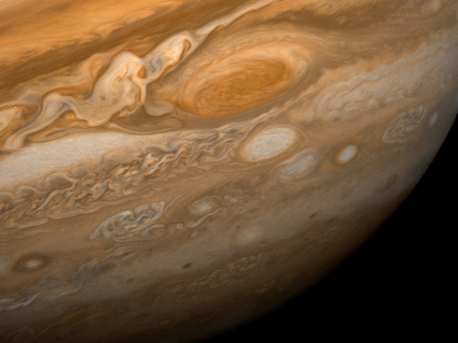
The Great Red Spot is a gigantic hurricane in Jupiter's atmosphere. This image was taken by the Voyager 1 space probe in 1979, at a distance of 5 million miles from the planet.
In reality, the 'spot' is a hurricane in Jupiter's atmosphere. The largest storm in our solar system is twice as far across as the diameter of Earth.
Jupiter is the largest planet in the Solar System. It is what is known as a gas giant, which is mostly made of hydrogen and helium and has no solid surface.
Mars - The planet with the spectacular colored storms.
The cloud layers are always moving in Jupiter's atmosphere. Their lively colors range from white, orange and yellow to brown and are thought to be created by chemical reactions of trace elements with sulphur - whose compounds are known to be very colorful. The color of the Great Red Spot is most likely due to the presence of phosphorus.
Astronomers still don't understand why this gigantic storm in Jupiter's southern hemisphere has lasted so long. The winds in its interior blow at speeds up to 250 miles an hour. It is possible that the Great Red Spot swallows up smaller storm systems and this is what has kept it going for such a long time.
German Aerospace Center
Jupiter is the largest planet in the Solar System. It is what is known as a gas giant, which is mostly made of hydrogen and helium and has no solid surface.
Mars - The planet with the spectacular colored storms.
The cloud layers are always moving in Jupiter's atmosphere. Their lively colors range from white, orange and yellow to brown and are thought to be created by chemical reactions of trace elements with sulphur - whose compounds are known to be very colorful. The color of the Great Red Spot is most likely due to the presence of phosphorus.
Astronomers still don't understand why this gigantic storm in Jupiter's southern hemisphere has lasted so long. The winds in its interior blow at speeds up to 250 miles an hour. It is possible that the Great Red Spot swallows up smaller storm systems and this is what has kept it going for such a long time.
German Aerospace Center



Beautiful storms on Mars
Where does a storm last for several centuries?
The longest documented storm on Earth lasted for just five weeks. Last year, astronomers observed a storm on Saturn that lasted for more than five months. However, on Jupiter, scientists in the 17th century observed a gigantic 'red eye' - known as the Great Red Spot – that has been observed continuously ever since and can be seen with amateur telescopes.
© NASA |
The Great Red Spot is a gigantic hurricane in Jupiter's atmosphere. This image was taken by the Voyager 1 space probe in 1979, at a distance of 5 million miles from the planet.
In reality, the 'spot' is a hurricane in Jupiter's atmosphere. The largest storm in our solar system is twice as far across as the diameter of Earth.
Jupiter is the largest planet in the Solar System. It is what is known as a gas giant, which is mostly made of hydrogen and helium and has no solid surface.
Mars - The planet with the spectacular colored storms.
The cloud layers are always moving in Jupiter's atmosphere. Their lively colors range from white, orange and yellow to brown and are thought to be created by chemical reactions of trace elements with sulphur - whose compounds are known to be very colorful. The color of the Great Red Spot is most likely due to the presence of phosphorus.
Astronomers still don't understand why this gigantic storm in Jupiter's southern hemisphere has lasted so long. The winds in its interior blow at speeds up to 250 miles an hour. It is possible that the Great Red Spot swallows up smaller storm systems and this is what has kept it going for such a long time.
German Aerospace Center
Jupiter is the largest planet in the Solar System. It is what is known as a gas giant, which is mostly made of hydrogen and helium and has no solid surface.
Mars - The planet with the spectacular colored storms.
The cloud layers are always moving in Jupiter's atmosphere. Their lively colors range from white, orange and yellow to brown and are thought to be created by chemical reactions of trace elements with sulphur - whose compounds are known to be very colorful. The color of the Great Red Spot is most likely due to the presence of phosphorus.
Astronomers still don't understand why this gigantic storm in Jupiter's southern hemisphere has lasted so long. The winds in its interior blow at speeds up to 250 miles an hour. It is possible that the Great Red Spot swallows up smaller storm systems and this is what has kept it going for such a long time.
German Aerospace Center


- Terms of use
- Privacy Policy
- About us
- Contact us
- FAQ
- Report abuse
- Subscribe to the newsletter
- Partner Program
- Advertise with us
- Partners
- Sitemap
- Muster-Widerrufsformular
* Alle Preise inkl. gesetzl. MwSt. Zahlung- & Versandinformationen unseres Partners HQ Media
Beautiful storms on Mars
Where does a storm last for several centuries?
The longest documented storm on Earth lasted for just five weeks. Last year, astronomers observed a storm on Saturn that lasted for more than five months. However, on Jupiter, scientists in the 17th century observed a gigantic 'red eye' - known as the Great Red Spot – that has been observed continuously ever since and can be seen with amateur telescopes.
© NASA |
The Great Red Spot is a gigantic hurricane in Jupiter's atmosphere. This image was taken by the Voyager 1 space probe in 1979, at a distance of 5 million miles from the planet.
In reality, the 'spot' is a hurricane in Jupiter's atmosphere. The largest storm in our solar system is twice as far across as the diameter of Earth.
Jupiter is the largest planet in the Solar System. It is what is known as a gas giant, which is mostly made of hydrogen and helium and has no solid surface.
Mars - The planet with the spectacular colored storms.
The cloud layers are always moving in Jupiter's atmosphere. Their lively colors range from white, orange and yellow to brown and are thought to be created by chemical reactions of trace elements with sulphur - whose compounds are known to be very colorful. The color of the Great Red Spot is most likely due to the presence of phosphorus.
Astronomers still don't understand why this gigantic storm in Jupiter's southern hemisphere has lasted so long. The winds in its interior blow at speeds up to 250 miles an hour. It is possible that the Great Red Spot swallows up smaller storm systems and this is what has kept it going for such a long time.
German Aerospace Center
Jupiter is the largest planet in the Solar System. It is what is known as a gas giant, which is mostly made of hydrogen and helium and has no solid surface.
Mars - The planet with the spectacular colored storms.
The cloud layers are always moving in Jupiter's atmosphere. Their lively colors range from white, orange and yellow to brown and are thought to be created by chemical reactions of trace elements with sulphur - whose compounds are known to be very colorful. The color of the Great Red Spot is most likely due to the presence of phosphorus.
Astronomers still don't understand why this gigantic storm in Jupiter's southern hemisphere has lasted so long. The winds in its interior blow at speeds up to 250 miles an hour. It is possible that the Great Red Spot swallows up smaller storm systems and this is what has kept it going for such a long time.
German Aerospace Center