
Dark Nights
Why Is It Dark At Night?
 © Contactni (CC-BY-SA 2.0) |
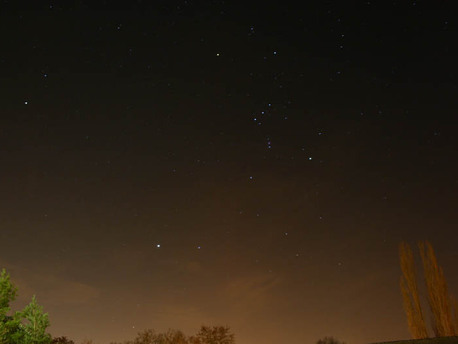
The photo shows the night sky over Halle, Germany, in winter, looking south. If we lived in an infinite Universe that was filled evenly with stars or galaxies, then in every direction we would sooner or later catch a glimpse of a star – the night sky would have to shine as brightly as the surface of the Sun.
In 1826 the German doctor and astronomer Heinrich Wilhelm Olbers encountered this problem, which has come to be known as Olbers' paradox. Various proposals for solving the paradox have been discussed since then. It could be suggested, for example, that opaque gas or dust clouds between the stars prevent the propagation of light. However, these clouds would absorb the radiation, heat up in the process and, after a time, start to radiate – they therefore do not provide an explanation for the nocturnal darkness.
The observable cosmos: not infinitely large, not an infinite number of stars
Our current model of the Universe provides one solution. The Universe was formed a finite period of time ago and it is expanding and developing. The age of the Universe multiplied by the speed of light defines the boundary of observable space. The light from objects that are beyond this boundary cannot have reached us yet. Added to this is the fact that the expansion of the Universe lengthens the wavelength of the radiation and thus depletes its energy. Thus the further away the region, the less radiation energy reaches us. The cosmic background radiation that was formed several hundred thousand years after the Big Bang lit up the Universe brightly in the beginning. Over time its wavelength has shifted from the visible range to the microwave range and thus the human eye can no longer perceive it.
Source: German Aerospace Center



Dark Nights
Why Is It Dark At Night?
© Contactni (CC-BY-SA 2.0) |
The photo shows the night sky over Halle, Germany, in winter, looking south. If we lived in an infinite Universe that was filled evenly with stars or galaxies, then in every direction we would sooner or later catch a glimpse of a star – the night sky would have to shine as brightly as the surface of the Sun.
In 1826 the German doctor and astronomer Heinrich Wilhelm Olbers encountered this problem, which has come to be known as Olbers' paradox. Various proposals for solving the paradox have been discussed since then. It could be suggested, for example, that opaque gas or dust clouds between the stars prevent the propagation of light. However, these clouds would absorb the radiation, heat up in the process and, after a time, start to radiate – they therefore do not provide an explanation for the nocturnal darkness.
The observable cosmos: not infinitely large, not an infinite number of stars
Our current model of the Universe provides one solution. The Universe was formed a finite period of time ago and it is expanding and developing. The age of the Universe multiplied by the speed of light defines the boundary of observable space. The light from objects that are beyond this boundary cannot have reached us yet. Added to this is the fact that the expansion of the Universe lengthens the wavelength of the radiation and thus depletes its energy. Thus the further away the region, the less radiation energy reaches us. The cosmic background radiation that was formed several hundred thousand years after the Big Bang lit up the Universe brightly in the beginning. Over time its wavelength has shifted from the visible range to the microwave range and thus the human eye can no longer perceive it.
Source: German Aerospace Center


- Terms of use
- Privacy Policy
- About us
- Contact us
- FAQ
- Report abuse
- Subscribe to the newsletter
- Partner Program
- Advertise with us
- Partners
- Sitemap
- Muster-Widerrufsformular
* Alle Preise inkl. gesetzl. MwSt. Zahlung- & Versandinformationen unseres Partners HQ Media
Dark Nights
Why Is It Dark At Night?
© Contactni (CC-BY-SA 2.0) |
The photo shows the night sky over Halle, Germany, in winter, looking south. If we lived in an infinite Universe that was filled evenly with stars or galaxies, then in every direction we would sooner or later catch a glimpse of a star – the night sky would have to shine as brightly as the surface of the Sun.
In 1826 the German doctor and astronomer Heinrich Wilhelm Olbers encountered this problem, which has come to be known as Olbers' paradox. Various proposals for solving the paradox have been discussed since then. It could be suggested, for example, that opaque gas or dust clouds between the stars prevent the propagation of light. However, these clouds would absorb the radiation, heat up in the process and, after a time, start to radiate – they therefore do not provide an explanation for the nocturnal darkness.
The observable cosmos: not infinitely large, not an infinite number of stars
Our current model of the Universe provides one solution. The Universe was formed a finite period of time ago and it is expanding and developing. The age of the Universe multiplied by the speed of light defines the boundary of observable space. The light from objects that are beyond this boundary cannot have reached us yet. Added to this is the fact that the expansion of the Universe lengthens the wavelength of the radiation and thus depletes its energy. Thus the further away the region, the less radiation energy reaches us. The cosmic background radiation that was formed several hundred thousand years after the Big Bang lit up the Universe brightly in the beginning. Over time its wavelength has shifted from the visible range to the microwave range and thus the human eye can no longer perceive it.
Source: German Aerospace Center